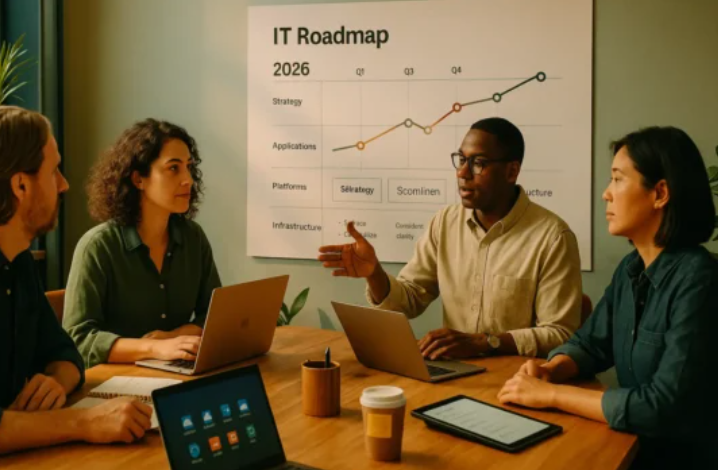
By 2026, companies no longer measure progress through digital adoption alone. The focus now sits on which technologies reduce delay, control cost, and support growth without expanding headcount. Global digital spend continues to rise, with IDC projecting business technology investment to exceed $3.4 trillion in 2026.
Most of this spend targets systems that replace manual processes, unify data, and support access across devices. Companies that delay these upgrades already report slower response times and weaker margins compared to peers that moved earlier.
Mobile-First Access Across Web and App Systems
Mobile access now defines the way customers use services. Over 65 percent of all digital interactions occur on mobile devices, according to Statista. That number continues to rise, which makes mobile support a default requirement.


Companies use frameworks such as React Native and Flutter to build features once and deploy them across iOS, Android, and web browsers. This improves consistency and reduces platform costs. Teams are now expected to maintain both app and web versions, with shared user states, real-time updates, and session synchronization.
This shift now applies to sectors beyond retail or logistics. In the iGaming sector, especially, mobile compatibility now shapes platform design from the start. Providers need applications that support full user control and run a wide range of slot games and other formats without separate systems. These games must work inside native apps and online versions, update reliably, and meet real-time performance benchmarks. Cross-platform stability is now as important as the games themselves.
AI and Automation With Defined Operational Use
AI systems now support cost control, demand planning, and early risk alerts. More than 70 percent of enterprises use AI for revenue-linked use cases, according to Gartner. Instead of general experiments, the focus is now on targeted models inside supply, finance, or customer support.
Machine learning is used to review pricing models weekly, adjust for known demand signals, or reduce manual audits in finance. AI tools are also applied in loss prevention and product recommendation pipelines.
Robotic process automation, often paired with AI models, now replaces manual steps in tasks like invoice checks, payroll, or contract review. Companies that run AI with human oversight report better error control and shorter cycle times. Technology no longer replaces workers; it now extends what small teams can manage at speed.
Cloud Integration With Shared Data Across Functions
Cloud systems now act as the operational core for most businesses. Instead of hosting separate tools across teams, companies now build connected platforms where sales, finance, operations, and product teams use the same data sources.
Enterprise resource planning (ERP) systems link directly with customer records, logistics tracking, and analytics layers. This integration replaces the siloed model, where decisions were formed in isolation and updates often arrived too late to act on. In 2026, over 85 percent of enterprises are expected to operate multi-cloud environments, according to Flexera.
This shift allows firms to balance cost, performance, and geographic reach while avoiding dependence on a single vendor. Workloads are split across providers based on use case, with sensitive data often kept closer to home for compliance reasons. Redundancy is built in, reducing downtime during load spikes or provider outages.
Remote Work Infrastructure Built for Performance, Not Access
Digital work tools now serve as the base layer for business coordination. They go beyond enabling remote work. Shared systems such as Microsoft Teams, Notion, and Jira now act as the first place tasks are defined, tracked, and handed off.
Timelines are visible to all departments, and version control prevents rework. Approvals, revisions, and output are tracked inside these platforms without reliance on email chains.
Distributed hiring is no longer framed as a cost-saving tactic. It is now a direct response to skill shortages and project speed. These platforms support that shift by making output visible in real time. Access, context, and review are all built into the workstream itself. Staff no longer wait for instructions; they work within structured environments that support progress across regions.
Real-Time Data Systems That Shape Operational Direction
Data systems have moved past monthly reporting. In 2026, companies use real-time analytics to run pricing models, monitor supply performance, and track campaign performance live.
Business platforms connect to tools like Looker, Power BI, or Snowflake to provide cross-functional visibility. This allows sales to react to traffic drops, operations to react to supply issues, and finance to catch shifts before quarter-end.
Predictive tools now support expansion decisions. Companies model potential product lines, pricing brackets, or regional launches before they commit. These models use internal and public data to produce outcome scenarios. This reduces failed product attempts and makes market entry less dependent on guesswork. Data is no longer the result of decisions; it guides them before they lock in.